AI Opener is now Tisser

Everyone can make things with AI.
Scaling is the hard part.

One person with a chat window is fine. Forty product pages a week, past brand and legal, in a voice that holds. That’s where it breaks. Tisser is the AI workspace that knows your business: your tone, your catalog, your rules. Work comes back finished, and nothing goes out until someone on your team signs it.

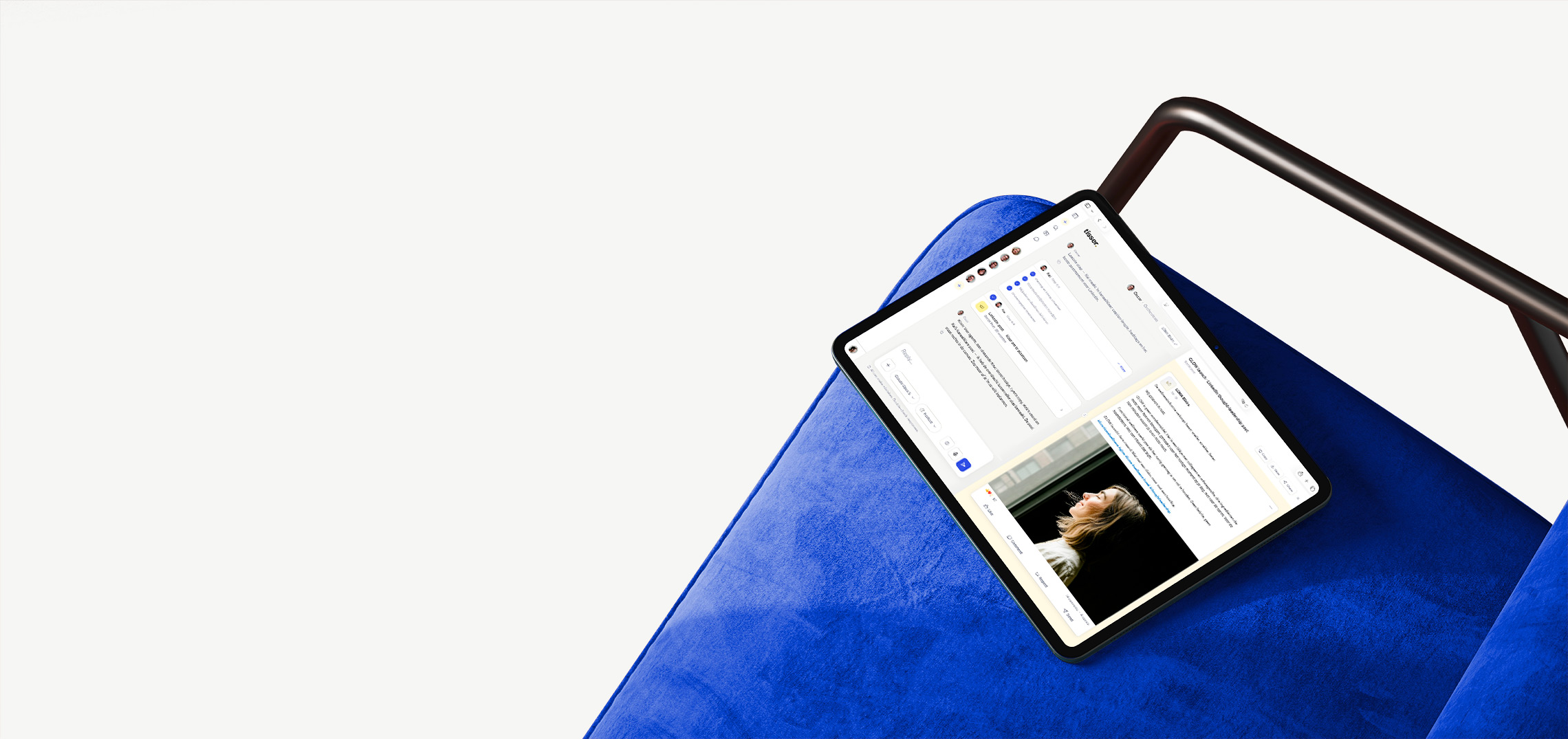
Tisser on a tablet, resting on a cobalt velvet chair

In production, not in pilot.

The same gap, felt three ways.

Nobody needs convincing that the models are good. The gap opens right after: the moment the work has to run wider than one enthusiast. Marketing and sales want speed, IT wants control, leadership wants to see it going somewhere. Same gap, three seats at the table.

Marketing and sales

“Two people, same brief, two different answers.”

My best people spend the week checking, chasing and redoing instead of making.

IT and compliance

“Half of this is already running, and I don’t know through what.”

I need to know what’s in use, where our data goes, and who signed off before it ships.

Leadership

“We keep spending, and I still can’t show what it’s returned.”

I want to know it’s going somewhere, not just costing more every quarter.
A commercial lead leaning back in a butter-yellow chair by a window, at ease

The workspace

Your brand. Your team.
Your rules. One place to work.

Everything the work needs, in the place where the work happens: your brand, your specialists, your projects. Five screens, in the order it happens.

Your brand,
written down once.

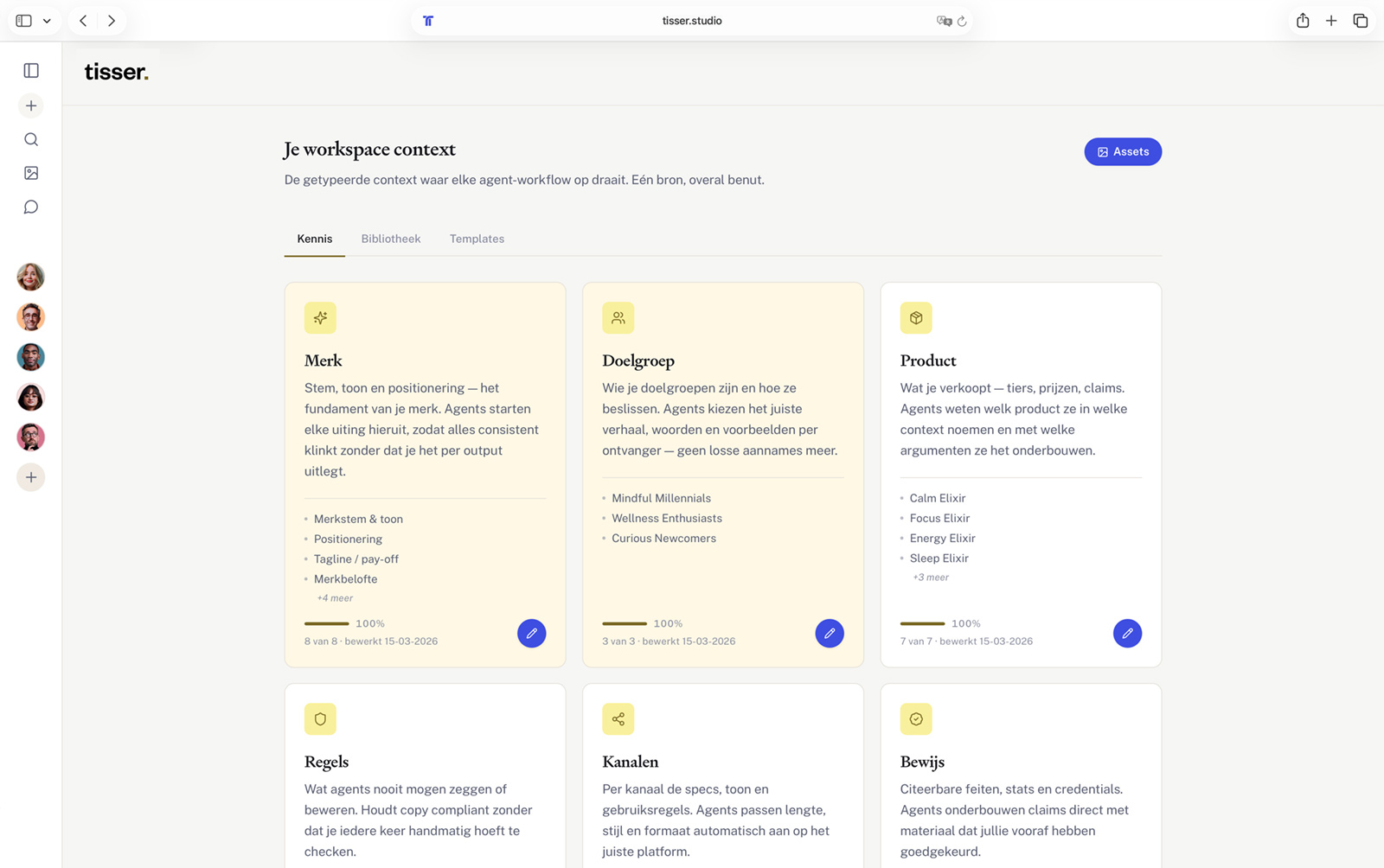
Voice, audience, claims, compliance, channels: your whole brand lives in one place. Every agent and every workflow works from it, so everything Tisser makes sounds like you. Without explaining it again for every job.

Specialists, not one
generic assistant.

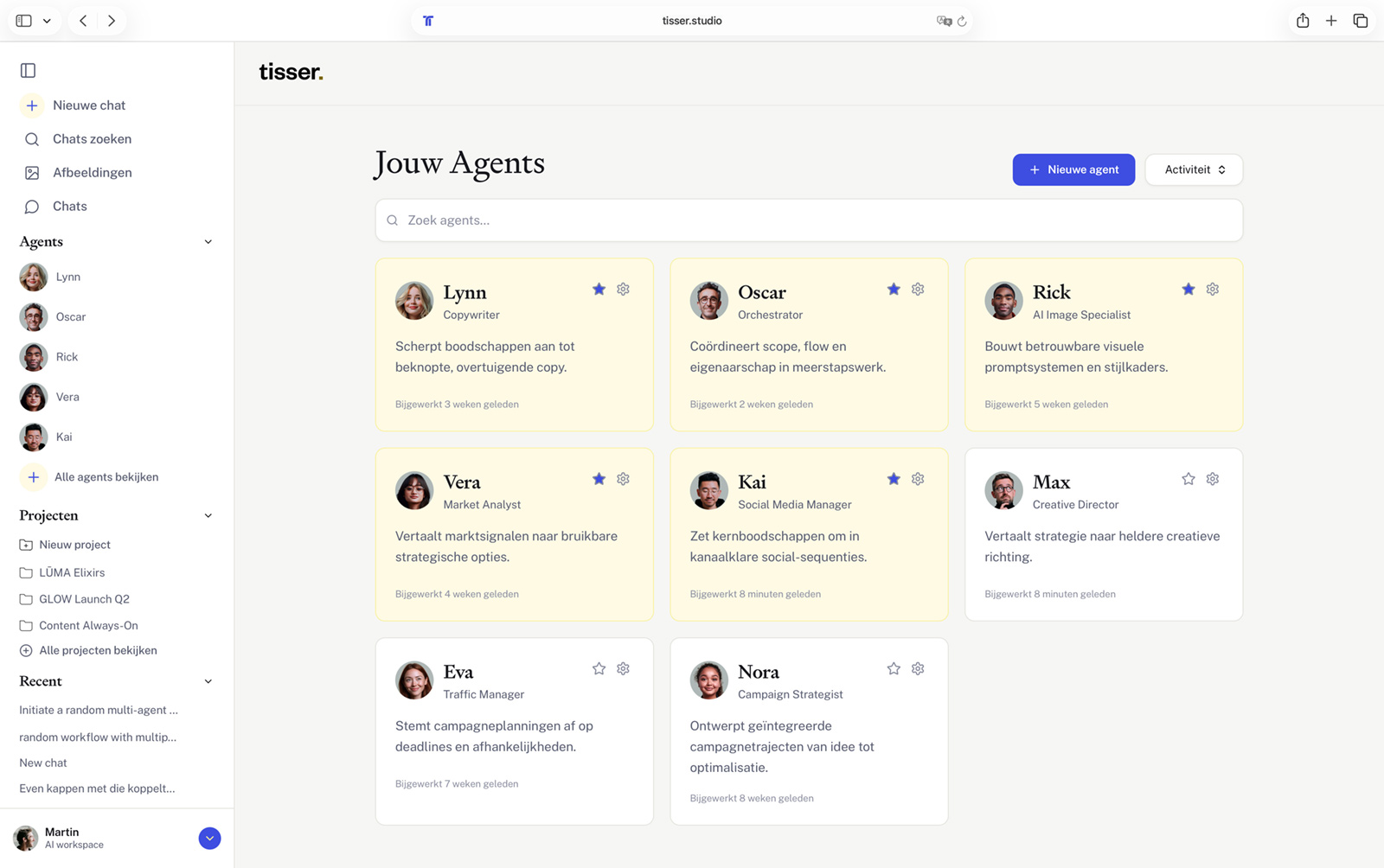
A copywriter, a market analyst, an image specialist, an orchestrator. Every agent has a role, a memory and your brand context. Not one tool that does everything. A team where each one adds what the others don’t.

Change the model,
not the rules.

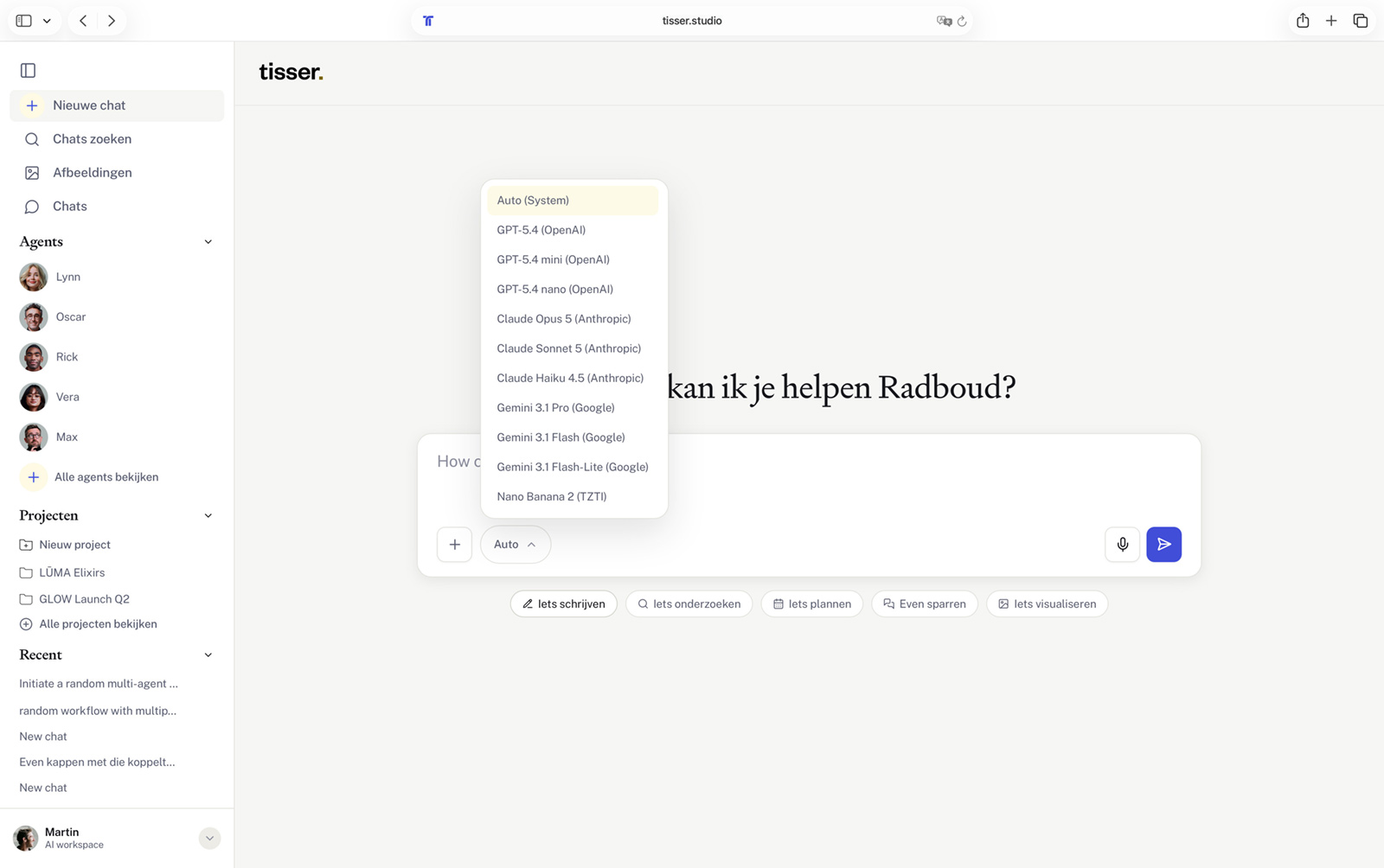
GPT, Claude, Gemini, Nano Banana: pick the best model per task, or let Tisser pick for you. Your context and your rules stay underneath, whichever one runs it.

Images run on
the same rules.

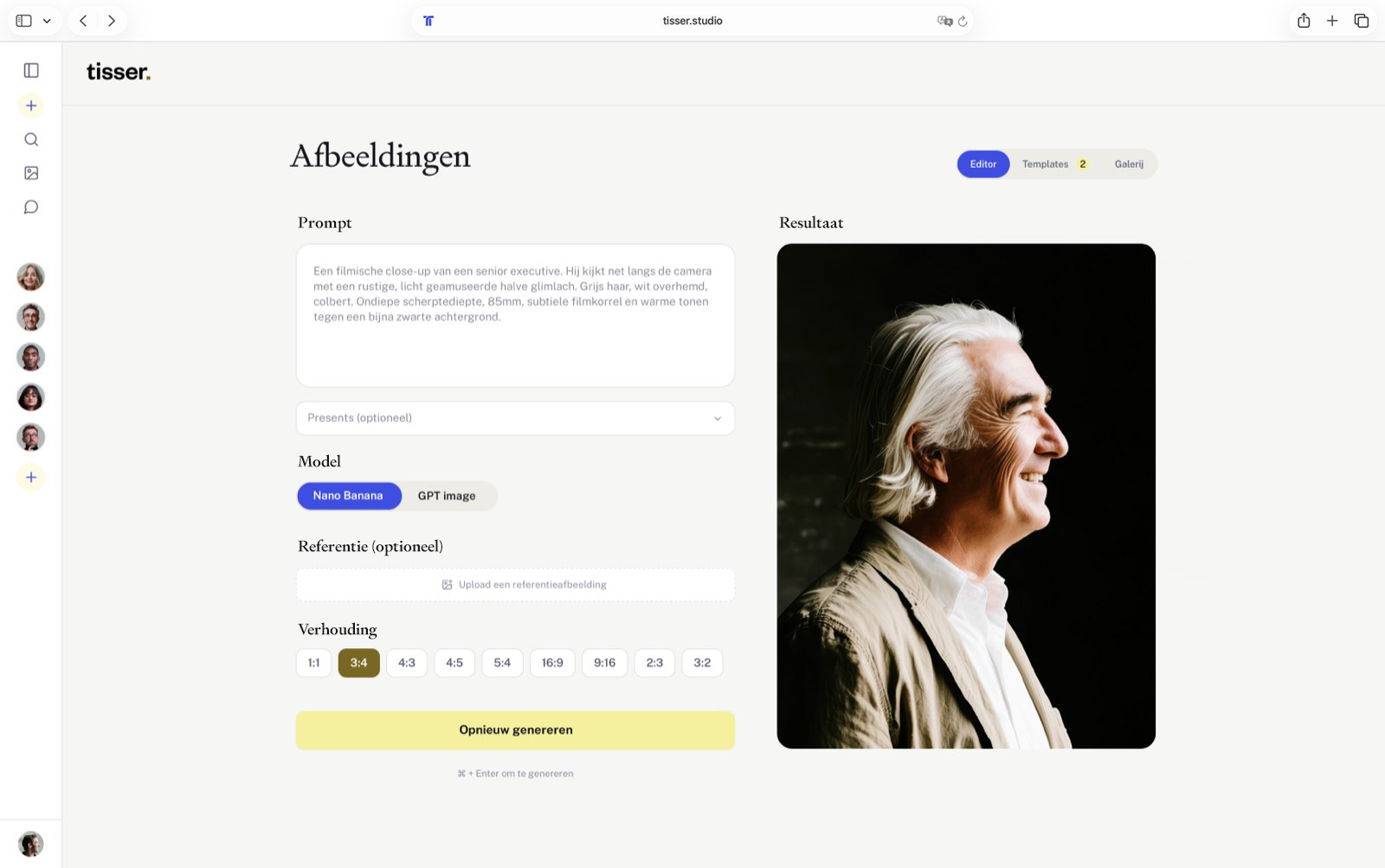
Generate and edit visuals that fit your brand, in any ratio. From packshot to editorial portrait, right next to the copy, so the words and the picture come out of the same source.

All your work,
per project.

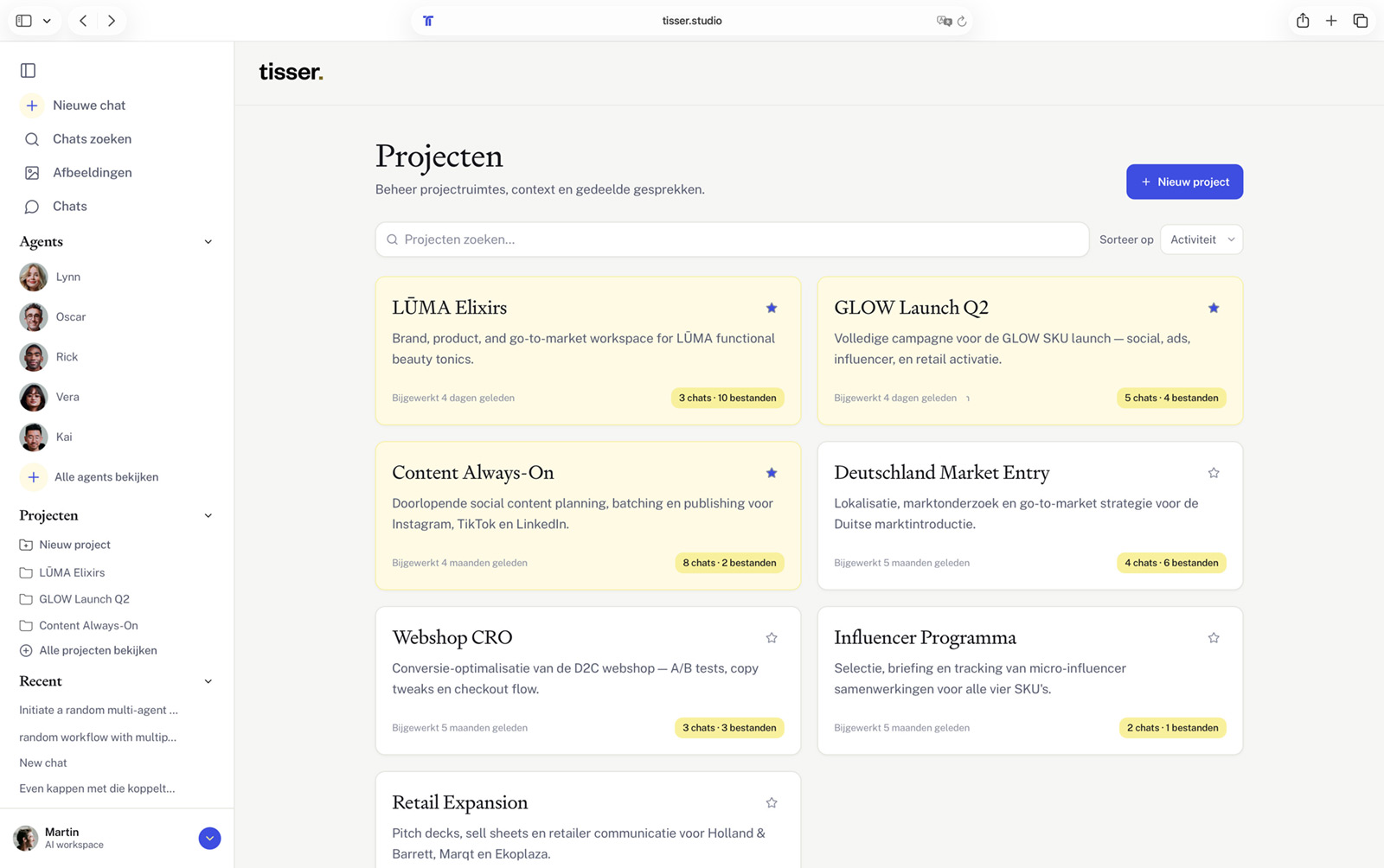
Launches, campaigns, markets: every project is its own space with its own context, chats and files. Everything the team makes stays together, and stays findable.

  1. Brand context
  2. Your agents
  3. Model choice
  4. On-brand images
  5. Project spaces
The workspace context screen: nine cards covering brand, audience, product, rules, channels, proof, campaigns, competitors and sales play
The agent overview: a copywriter, orchestrator, image specialist, market analyst and more, each with their own role
The model picker open in a new chat, listing GPT, Claude, Gemini and Nano Banana side by side
The image editor: a prompt on the left, aspect ratio options, and the generated portrait on the right
The projects overview, each project card showing its own chats and files

From conversations to operations.

A chat window gives you an answer. Give Oscar one brief and he puts a team on it: specialists working at the same time, on your rules, handing back a finished package. One brief in, finished work back.

Scroll
Martin
“Set up a campaign for the holidays.”
Oscar Orchestrator
Sets the workflow and splits the work.
Delegating
Rafa Analytics Lead
Historical data and seasonal trends.
Analysing
May Brief Builder
Audience, channels and constraints.
Gathering context
Nora Strategist
Pillars and campaign logic.
Setting strategy
Lynn Copywriter
Copy for blog, social and app.
Writing
Rick Designer
Visuals for every channel.
Designing

CampaignPackage

Content, visuals and a report,
ready to roll out.

See it in action.

Step 1 / 5
The brief

Your team sleeps.
The work doesn’t.

Flows run through the night: research gathered, drafts built, first passes done. What’s waiting in the morning is work, not a to-do list. And nothing has gone out: it’s queued for someone to put their name on it.

See it work

Three things a chat window
won’t give you.

Draft · rule check

The fastest running shoe in the Netherlands, honestly.

It knows what you can’t say

Claims get checked against your own rules while the draft is still open, not after it went out.

A new model doesn’t reset your rules

Your rules sit above the model. When a better one ships it appears behind the same door, and nothing you wrote down has to change.

Built for the security review

Hosted in the EU, GDPR-compliant and AI Act-ready, on ISO 27001-certified Google Cloud infrastructure.

The team behind it

You are not left with just a login.

Behind the platform sits a team of specialists: ours, plus the AI hub we co-founded. Together we run what we call Compliant AI Teams: AI agents doing finished work inside your rules. We set it up with you and stay until it runs.

  • Onboarding with a builder

    Not a support portal. The person who set up your rules walks your team through them.

  • Your rules, written with you

    We sit down with brand, legal and marketing and turn what you already know into rules the engine can follow.

  • Short lines, no ticket queue

    One named contact, reachable in your own channel. Most questions get an answer the same working day.

  • A review before anything scales

    In week one you will edit a lot. That is the point: we sharpen the rules on your corrections, and then you widen the tap.

What people ask first.

Not answered here? Email hello@tisser.ai. A person reads it, and you get an answer within one working day.

Which teams actually work in this?

Marketing, sales and support. Product pages and campaign content, sales follow-ups and proposals, answers to customer questions. Different jobs, the same rules underneath and the same person signing off.

Who checks it before it goes out?

Someone on your team, by name. Anything leaving the company waits for them, and every decision is logged with a timestamp.

How much of our work can run through it?

There is no cap on it. The bottleneck is imagination rather than capacity: the more workflows your team can think up, the more of the work the agents take on.

What does it cost?

It depends on the shape of your setup: how many people work in it, how many agents and workflows you run, how many brands, how many systems you connect. That is why there is no calculator here. You get your figure on the intro call, whether you buy or not.

Where does our data live?

In the EU, on ISO 27001-certified Google Cloud infrastructure. Your text stays yours and is not used to train models. What is committed per model provider, we put in writing before you sign.

How is this different from ChatGPT with a good prompt?

A prompt is a suggestion and it lives with one person. Rules are written down, apply to everyone, and the work stops for approval before it goes out.

See it run, start to finish.

Thirty minutes with someone who built it, walking through the real thing: a brief going in, specialists drafting against the rules, the approval gate, and the trail it leaves behind. Technical and compliance questions are welcome on the first call.

Ask AI about Tisser: